If you know, you go.
Cochise Stronghold isn’t a name I’d come to associate with the All-American classic rock climbing areas. So, in the dreary rain of November in Revelstoke, BC sitting across the table brewing up ideas over a few brews I was surprised when it was suggested to check out Cochise Stronghold.
Located in Southern Arizona (4 hours from Phoenix, 2 hours from Tuscon), this gem hosts a large amount of mostly mixed (bolts & gear) lines up beautiful golden granite domes. The rock ranges from 5-star bomber granite, to 3-star somewhat grainy on the less travelled routes. There is some amazing patina style cruising up chickenheads and into a sea of plates for some easy runout romping, hard face/slab climbing, and not-so straightforward jamming.
Aside from the climbing there is some great camping available on the BLM land for free. There’s open sunny sites for winter, or downright shady sites for the summer. Despite its desert climate there’s plenty of greenery nearby to the crags, which must draw its own weather system. The town of Tombstone is only a 20-minute drive away to grab a bite to eat (breakfast particularly) and some water, but most people will want to cruise over to Benson (30-minutes) to stock up on groceries and other necessities.


The Climbing
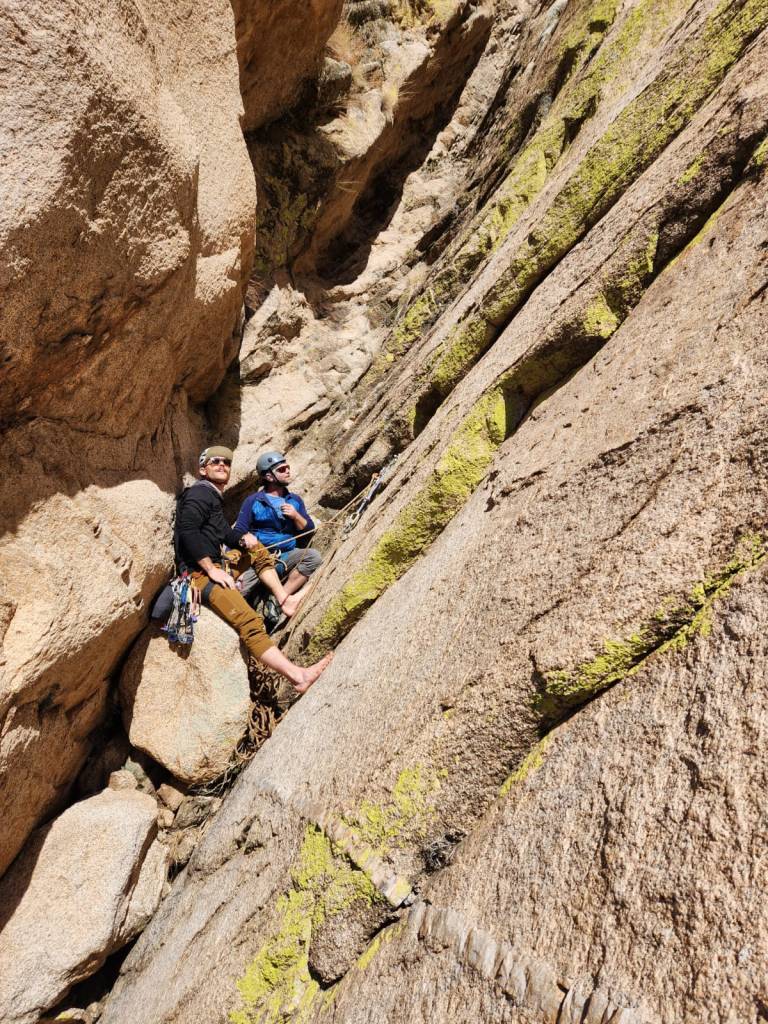
The character of this venue is certainly adventurous. Most of the routes range from 4-7 pitches in length, require at least a 30-minute approach, and most-often require a walk-off. Unlike Joshua Tree, this area is primarily slab-based with a few crack systems thrown in between, there’s often plenty of protection – but rarely are you cruising up a single sized (fingers, hands, fists) crack for longer than 8m. Although the area has a reputation for bold climbing, I personally found (especially on Sheepshead) that the bolts were adequate and only runout in the easier terrain. Rarely are you making insecure moves well above gear or a bolt so don’t shy away from those descriptions.
While the cracks that do exist tend to be of high-quality, for the most part I found that hands -> OW seem to be the vast majority of the popular routes. Similarly, while the routes are slabin character (ie. Less than 90 degrees) they tend to be well-featured with decent (albeit tiny) crimps available. It was my experience that I rarely was making a pure friction move, quite often it was finding the right miniscule features to place my toes and I wasn’t making too many palming moves before finding a ‘decent’ hold.
Grade wise there seems to be a solid spread in the 5.8 -> 5.11 range, with many of the 5.11+ routes receiving a PG or and R rating.
On our rather brief (12-day) trip, with some unfortunate bouts of snow, we were able to tick:
| Ewephoria (5.8+) | Mystery of the Desert (5.9+) |
| Blood Brother (10+) | Darkhorse (5.10) |
| Phony Pony (10-) | Cragoholics Dream (5.10+) |
And a smattering of Sport routes when escaping the snow and chasing the sun:
| Isle of Ewe (10b/c) | Jizzneyland (10c) |
| Fire in the Hole (10b) | Hell in a Handbasket (10c) |
| Stone Woman (10a) | Gringo en Quema (11b) |


Guidebooks
If you’re looking for some après climbing entertainment than look no further than the two available guidebooks from Tawyna Bok or Gier Hundal. There is clearly a difference of ethical opinion when it comes to how a climb should be established and the style it should be climbed in and these authors aren’t shy to express how they feel. In almost comedic fashion, you can read how Gier has, “personally led every climb in this book ground-up” or “climbs being neutered do to their establishment” or the face that the most-comprehensive guidebook to Cochise doesn’t include unethical routes. What this amounts to is large amounts of great routes being not-included due to their “rap-bolted” nature. In short, Gier clearly favors the ground-up ethic of climbing & development, and Tawyna Bok doesn’t push her opinion to hard, but categorizes all the climbing available, including Gier’s nemesis the rap-bolting ethic.
Regardless, we found it beneficial to have both guidebooks. In my opinion, Gier’s is much more thorough and has amazing route descriptions, history, and beta – as well as specific rack information and a topo with sizes of key-pieces on the route (ie. save a 0.75” for the corner before the roof). It’s clear that Gier has put his time into the Stronghold and the wealth of info is clearly evident. It is a shame however that there isn’t one conclusive guidebook for the area.
Tawyna’s is more visually stunning, has better navigational aides (maps, overhead views), and includes the many established “sport” routes that do have glued-on holds, and a rap-bolted nature – but are not included in Gier’s. While they share similar star (or doggie-paw) ratings for a good chunk, some of them differ wildly (such as Blood Brother, 5.10). So it’s nice to have a good idea of both.
Also to note, Mountain Project is really thorough in Cochise, and every… EVERY route can be found there with good enough descriptions and beta. But, come on, it’s nice to have the guidebook, no?
Camping
We only camped and climbing of the East side so I can’t speak to the National campground, or any private campgrounds on that side
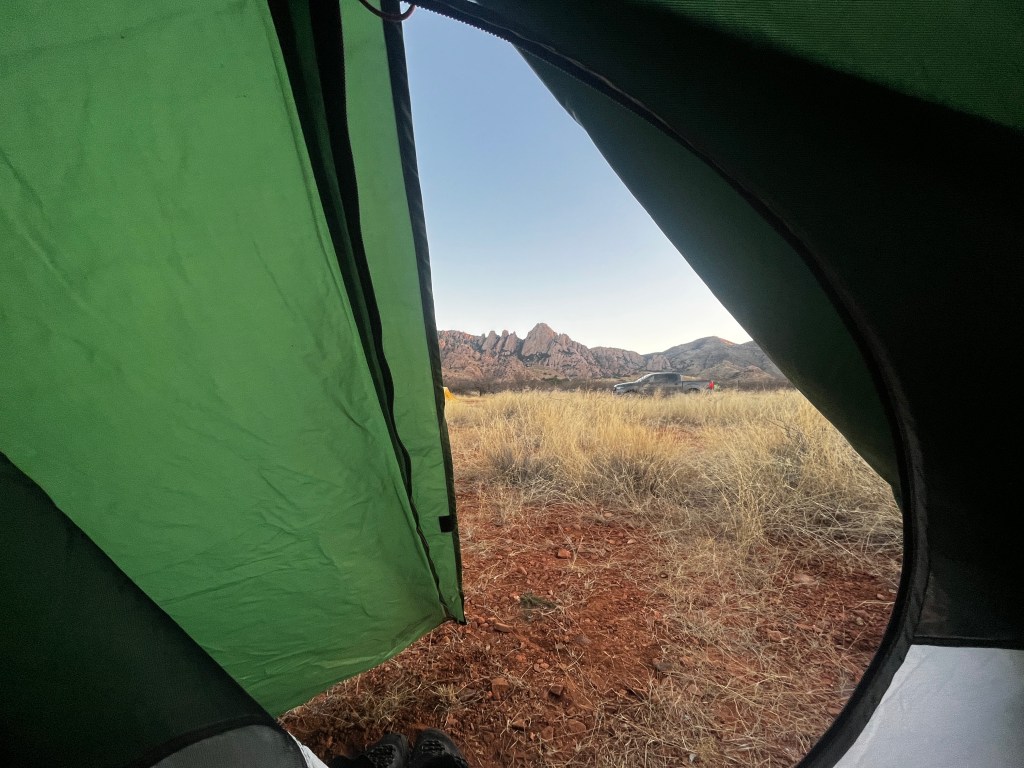
On the East side, there is tons of BLM land that is free to use for up to 14-days. There’s a great cul-de-sac style campground right near the entrance gate to Sheepshead. This is a great location for camper vans, sleep in rigs, or tenting with a group since you can leave right from your campsite to the trailhead without any driving.
We chose to camp just along near the entrance road and would take the 2-minute drive in to the crag on a daily basis. But we were pulling a trailer and wanted a bit more privacy so it worked for us.
There’s plenty of space for whatever you like, just make sure to bring a shovel to bury your poop and a lighter to burn that TP. It’s a delicate environment out there so be sure to leave it how you found it.

 of Backpacks and Beards
Beautiful reading
LikeLike